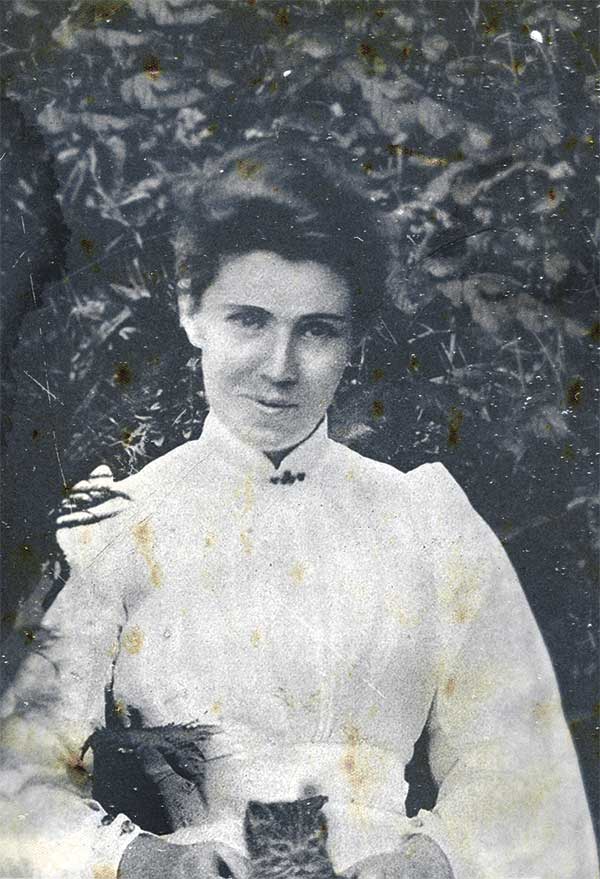
Amy Beatrice Carmichael was born on 15 December 1867 in the village of Millisle, County Down, Ireland, the eldest of seven children in a devout Presbyterian family. Her parents, David and Catherine Carmichael, were respected members of the local community, and the household was marked by sincere Christian faith, regular Scripture reading, and practical compassion for those in need. Amy’s childhood was shaped by the rugged beauty of the Irish coastline and by an early sensitivity to spiritual matters.
A well-known story from her youth illustrates her simple but earnest faith. As a little girl she disliked her brown eyes and prayed that God would change them to blue. When the colour did not alter, she felt disappointed, yet years later she recognised that her brown eyes enabled her to pass more easily as an Indian woman. This childhood lesson in unanswered prayer became for her an early education in trusting the wisdom of God.
The Carmichael family later moved to Belfast, where her father’s flour-milling business suffered financial collapse. The strain contributed to his early death in 1885, leaving the family in reduced circumstances. These difficulties deepened Amy’s reliance upon God and cultivated the resilience that would characterise her future ministry.
Call to Missionary Service
While attending a Keswick Convention in the late 1880s, Carmichael experienced a profound spiritual awakening and a growing conviction that she was called to missionary service. Influenced by the holiness teaching of the convention and by the writings of Hudson Taylor, she offered herself to the Church Missionary Society (CMS). Her first appointment was to Japan in 1893, yet ill health forced her return after only fifteen months.
Undeterred, she sought another field of service and in 1895 travelled to India under the auspices of the Church of England Zenana Missionary Society. She initially worked in Bangalore and later in the Tamil region of southern India. From the outset she demonstrated an unusual willingness to identify with Indian culture: she adopted Indian dress, learned Tamil fluently, and rejected the colonial attitudes that often separated missionaries from the local people.
The Founding of the Dohnavur Fellowship
Carmichael’s life took a decisive turn in 1901 when she encountered a young Indian girl named Preena who had fled from a Hindu temple. The child had been dedicated to the temple as a devadasi, a system that frequently involved ritual prostitution. Shocked by this practice, Carmichael resolved to provide refuge for such children. What began as the care of a single girl grew rapidly into a large community.
In Dohnavur, near Tirunelveli in Tamil Nadu, she established an orphanage and later a broader mission known as the Dohnavur Fellowship. The community became home to hundreds of children, mostly girls, but eventually boys as well, rescued from exploitation or abandonment. Carmichael insisted that the fellowship should be thoroughly Indian in character: the children were given Indian names, wore Indian clothing, and were taught in their own languages. She believed that the gospel must take root in indigenous soil rather than in imported Western forms.
Her leadership was marked by firm discipline, deep affection, and unshakeable faith. She refused to publicise photographs of the children or engage in emotional fund-raising, trusting instead that God would supply the mission’s needs. The fellowship included schools, homes, and medical care, and it trained Indian Christian workers to continue the ministry.
Fifty-Five Years of Service
Except for brief furloughs, Amy Carmichael remained in India for fifty-five years, never returning permanently to her homeland. In 1931 she suffered a severe fall that left her largely confined to bed. Far from ending her usefulness, this period became one of remarkable literary productivity. From her room in Dohnavur she continued to guide the fellowship and to write extensively, offering spiritual counsel to Christians around the world.
Carmichael was known for her uncompromising devotion. She never married, believing that singleness enabled her complete dedication to the children entrusted to her. Her theology emphasised sacrificial love, obedience, and the hidden life with Christ. To the children she was “Amma,” the Tamil word for mother.
Literary Contributions
Over the course of her life Carmichael wrote thirty-five books, as well as numerous poems and articles. Her writings combined vivid narrative with devotional reflection and played a significant role in awakening Western Christians to the realities of Indian life and to the cost of discipleship. Among her most influential works were:
- “Things as They Are” (1903) – an early account exposing the devadasi system and describing the beginnings of rescue work.
- “If” (1938) – a searching meditation on the nature of Calvary love, widely used for personal devotion.
- “Gold Cord” (1932) – reflections on the principles that bound the Dohnavur community together.
- “Rose from Brier” (1933) and “Edges of His Ways” (1955) – collections of spiritual insights drawn from daily experience.
Her prose was marked by poetic sensitivity and practical realism. She avoided romantic portrayals of mission life, writing candidly of discouragements, cultural misunderstandings, and the slow growth of faith. These qualities have kept her books in print long after her death.
Character and Influence
Carmichael’s personality combined gentleness with formidable determination. She opposed both caste prejudice and the paternalism sometimes practised by Western missions. Indian Christians who worked with her later testified that she treated them as true partners rather than subordinates. The Dohnavur Fellowship became a model of contextualised mission, emphasising family life, education, and spiritual formation.
Her stance was not without critics. Some contemporaries considered her methods unconventional, particularly her refusal to baptise converts hastily and her independence from established mission boards. Others felt that her strict communal discipline was severe. Yet even critics acknowledged her integrity and the tangible protection she provided to vulnerable children.
Final Years and Death
Amy Carmichael continued to guide the fellowship from her sickroom until her final days. She requested that no stone mark her grave, desiring that attention remain upon Christ rather than upon herself. She died at Dohnavur on 18 January 1951, aged eighty-three. The simple inscription placed there by the children reads only “Amma.”
Legacy
The Dohnavur Fellowship continues its work in southern India, caring for children and operating schools and community programmes. Carmichael’s writings remain a source of challenge to Christians worldwide, calling readers to costly compassion and to a life centred on the love of Christ. Her example stands as one of the most remarkable missionary testimonies of the twentieth century, an Irish woman who became a mother to hundreds in India and whose influence has reached far beyond the boundaries of her adopted land.


Leave a comment