
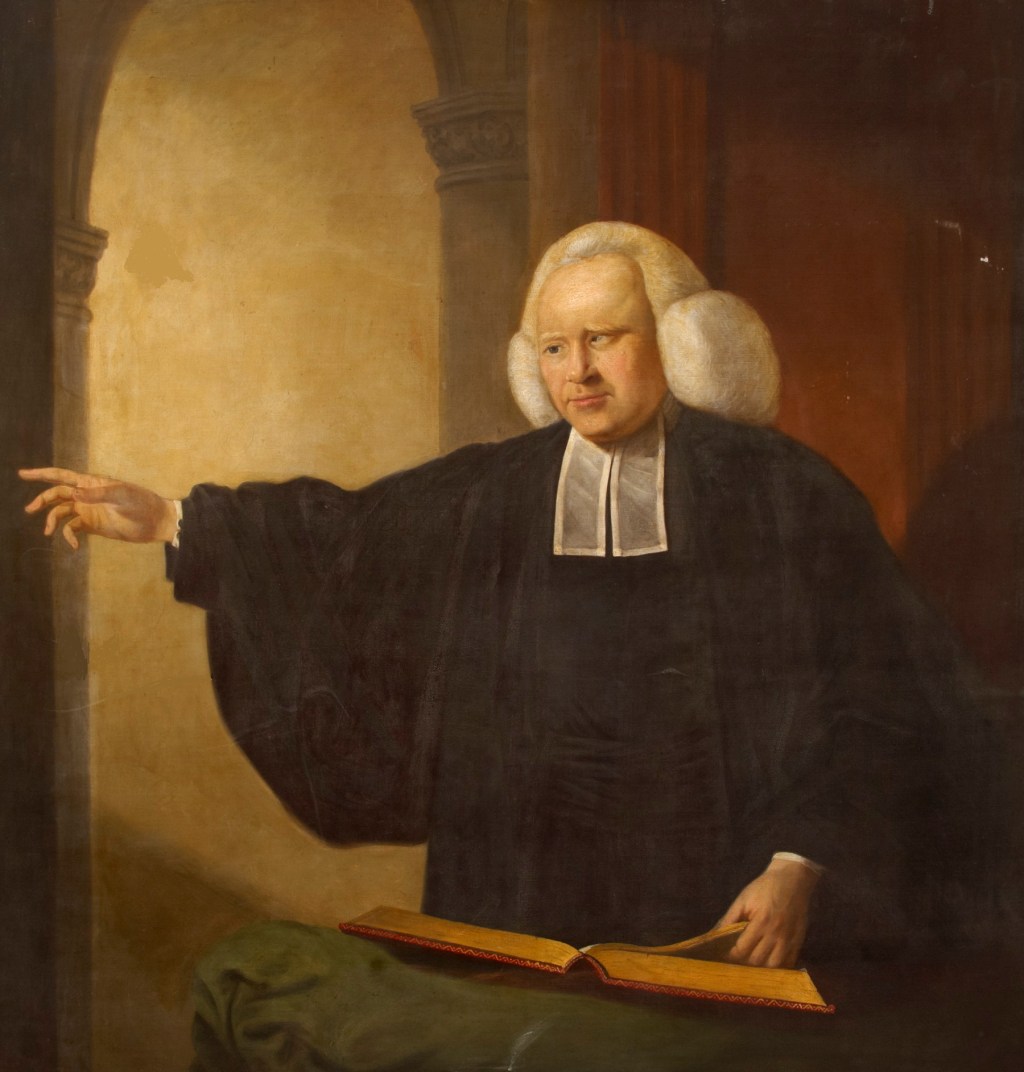
George Whitefield (1714–1770) stands as one of the most influential religious figures of the eighteenth century and a central architect of the Evangelical Revival known as the Great Awakening. A gifted preacher with an extraordinary voice and dramatic presence, Whitefield helped transform Protestant Christianity in Britain and the American colonies, emphasizing personal conversion, heartfelt faith, and the necessity of spiritual rebirth.
Early Life and Education
George Whitefield was born on December 16, 1714, in Gloucester, England, the youngest of seven children. Raised in modest circumstances after his father’s death, Whitefield assisted his mother in running an inn while pursuing his education. His academic promise eventually led him to Pembroke College, Oxford.
At Oxford, Whitefield became associated with the “Holy Club,” a small group of devout students that included John and Charles Wesley. The group was mocked for its methodical approach to spiritual discipline, giving rise to the term Methodist. During this period, Whitefield experienced a profound religious conversion that shaped his lifelong theology: salvation by grace through faith and the necessity of being “born again.”
Rise as a Preacher
Whitefield was ordained in the Church of England in 1736, but it quickly became clear that traditional parish preaching could not contain his talents. He possessed a booming yet musical voice, remarkable emotional range, and an ability to communicate complex theology in vivid, accessible language.
Denied many pulpits because of his unconventional style and emphasis on conversion, Whitefield turned to open-air preaching, addressing miners, laborers, and the poor, audiences often neglected by established churches. Tens of thousands reportedly gathered to hear him speak, sometimes moved to tears by his sermons. Contemporary observers noted that he could make listeners feel as though they were personally addressed, even in massive crowds.
The Great Awakening in Britain and America
Whitefield crossed the Atlantic seven times, preaching extensively throughout the American colonies. His tours helped unite disparate colonies in a shared religious experience, making him one of the first truly transatlantic celebrities. Newspapers followed his movements, and his sermons were widely published and read.
In America, Whitefield became a leading figure in the Great Awakening, a revival movement that challenged religious complacency and emphasized personal faith over formalism. While the movement revitalized Protestant Christianity, it also caused controversy, dividing churches between “New Lights,” who supported revivalism, and “Old Lights,” who opposed its emotionalism.
Theology and Controversies
Though associated with the Wesleys, Whitefield differed sharply from them on theology. He was a committed Calvinist, emphasizing God’s sovereignty and the doctrine of predestination, while John Wesley embraced Arminian views stressing free will. Despite this disagreement, Whitefield maintained a spirit of charity toward Wesley, famously declaring that they would both be united in heaven.
Whitefield was not without contradictions. He opposed slavery in principle yet later supported it in practice, particularly in Georgia, arguing (controversially) that it would improve economic conditions. This tension remains a significant and troubling aspect of his legacy.
Legacy and Influence
George Whitefield died on September 30, 1770, in Newburyport, Massachusetts, after preaching almost until the moment of his death. He was buried beneath the pulpit of Old South Presbyterian Church, symbolizing a life devoted entirely to preaching.
Whitefield’s impact was immense. He helped popularize evangelical Christianity. He demonstrated the power of mass communication in religion. He influenced later revivalists such as Jonathan Edwards and, centuries later, figures like Billy Graham.
Above all, Whitefield reshaped Protestant preaching by insisting that faith must engage the heart as well as the mind. His voice may be silent, but its echoes remain deeply embedded in the history of Christianity and the religious culture of the modern English-speaking world.



Leave a comment